

Email your managers a forecast of upcoming bookings
Schedule a recurring email that counts the bookings coming up and attaches a one-page PDF and the full list as a spreadsheet. About ten minutes, and you can send one immediately to check it arrives.
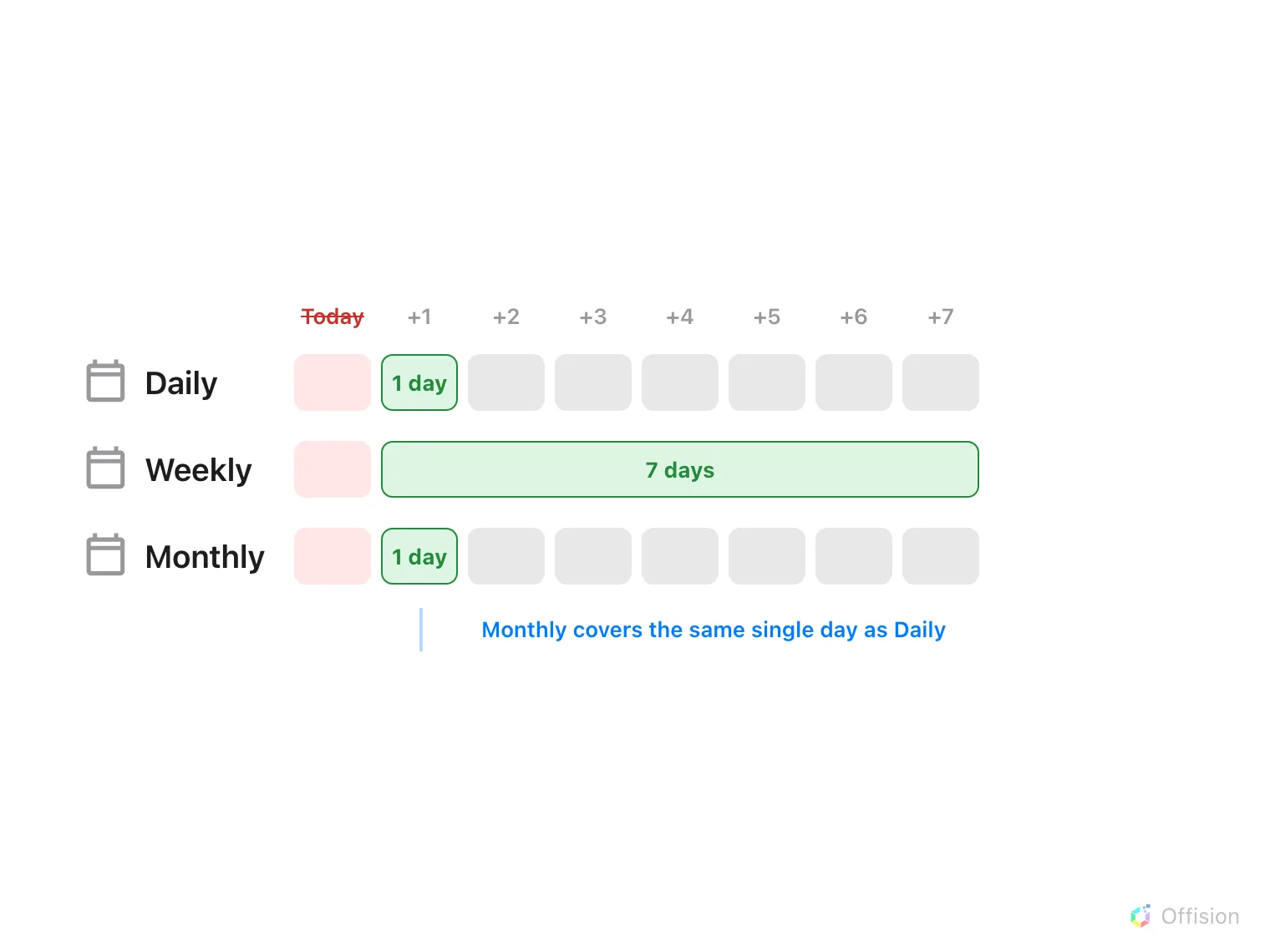
Every forecast starts tomorrow. The frequency chooses how often the email arrives, and only Weekly changes how much it covers.
1. Open the email report page
In the Booking module, the page sits under Settings in the list down the left — but it is not one of the pinned entries, so you have to choose Show more before Email report appears. That single step is where most people give up looking.
Open Email reportA subscription is a standing instruction: this report, this often, to these people, about these rooms. You can have as many as you like — a daily one for the facilities team and a weekly one for a department head are two separate subscriptions, not one compromise.
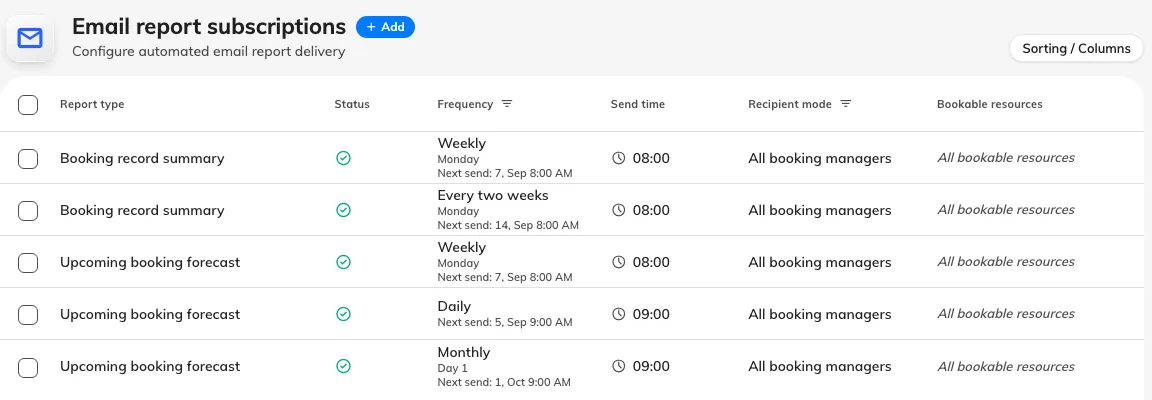
Three subscriptions on one page: a daily, a weekly and a monthly.
2. Add a subscription
Choose Add. The dialog opens on Report, showing the two reports the booking module publishes as cards: Booking record summary, the period just gone, and Upcoming booking forecast, the days ahead. A new subscription starts on the summary, so choose the forecast card. If it is the past you want reported on, the summary has an article of its own.
Everything else is on the rail down the left — Schedule, Recipients and Scope — under a pill reading Active. Choosing that pill pauses the report: it keeps every setting and every recipient and sends nothing until you turn it back on, which is how you stop a report for a month without losing who it went to.
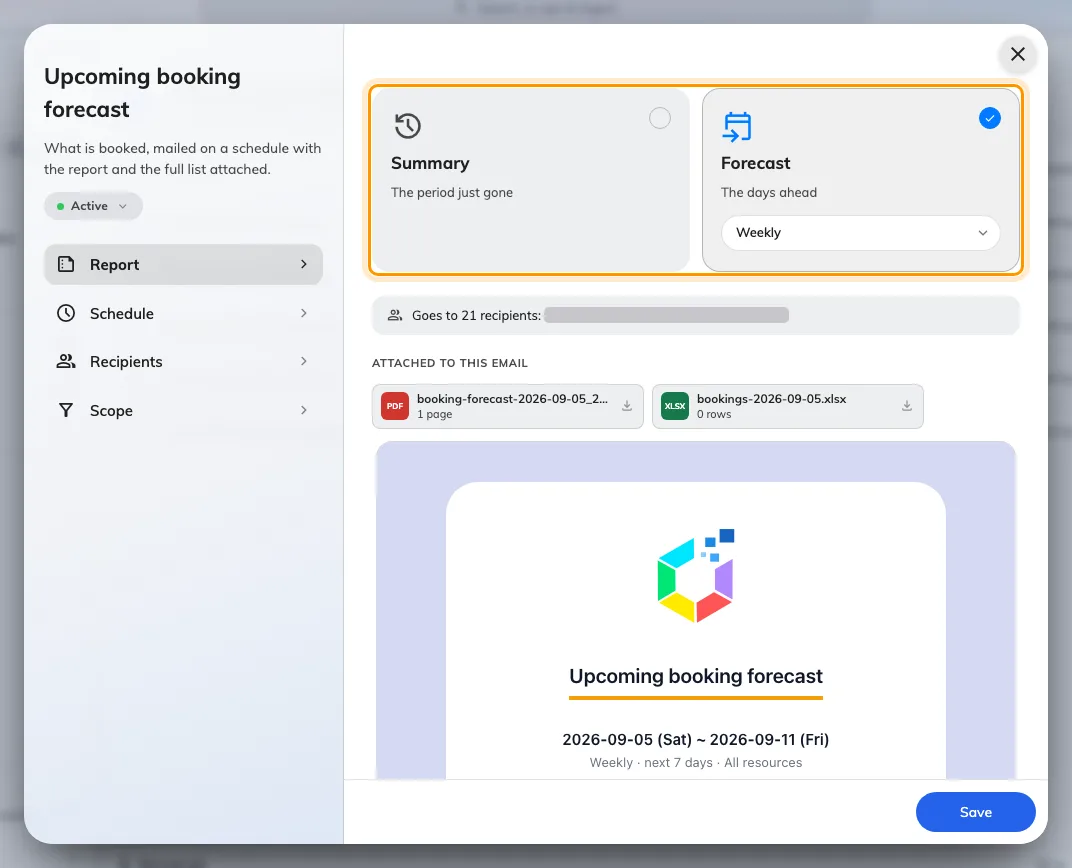
The Report page, with the forecast card chosen and its frequency on the pill beneath the name.
3. Choose how often it arrives
The frequency sits on the selected card, as a pill under its name.
| Frequency | Arrives | Covers |
|---|---|---|
| Daily | Every day | The next day |
| Weekly | The day of week you pick | The next seven days |
| Every two weeks | The day of week you pick, every second week | The next 14 days |
| Monthly | The day of month you pick, 1 to 28 | The next day |
Send time and the day of week or month are on Schedule, which also lists the next four sends and the period each one reports on — the quickest check that the schedule is what you meant.
Send time is honoured to the hour. Minutes are ignored, so 09:30 and 09:00 both send during the 9 o’clock hour. The hour is read in the system time zone, not the reader’s, so a manager abroad receives it at their local equivalent of your working morning rather than theirs.
Day of month stops at 28 deliberately — 29, 30 and 31 do not exist in every month, and a report scheduled for a day that never comes never arrives.
4. Choose who receives it
Recipients, on the rail, offers two modes:
- All booking managers — everyone holding Booking manager or Global administrator, resolved fresh at the moment each report is sent. People joining or leaving that role are picked up without anyone editing the subscription. This is the right choice for a standing operational report.
- Specify recipients — name individual people, user groups, or both. From 4.5.9 a user group is expanded to its members when the report is sent, so a group stays current as people join and leave it.
Either way, recipients are filtered to people who hold Booking manager or Global administrator. Naming someone without those rights, directly or through a group, does not add them — a subscription is a convenient way to address managers, never a way to grant sight of bookings to somebody who cannot otherwise see them.
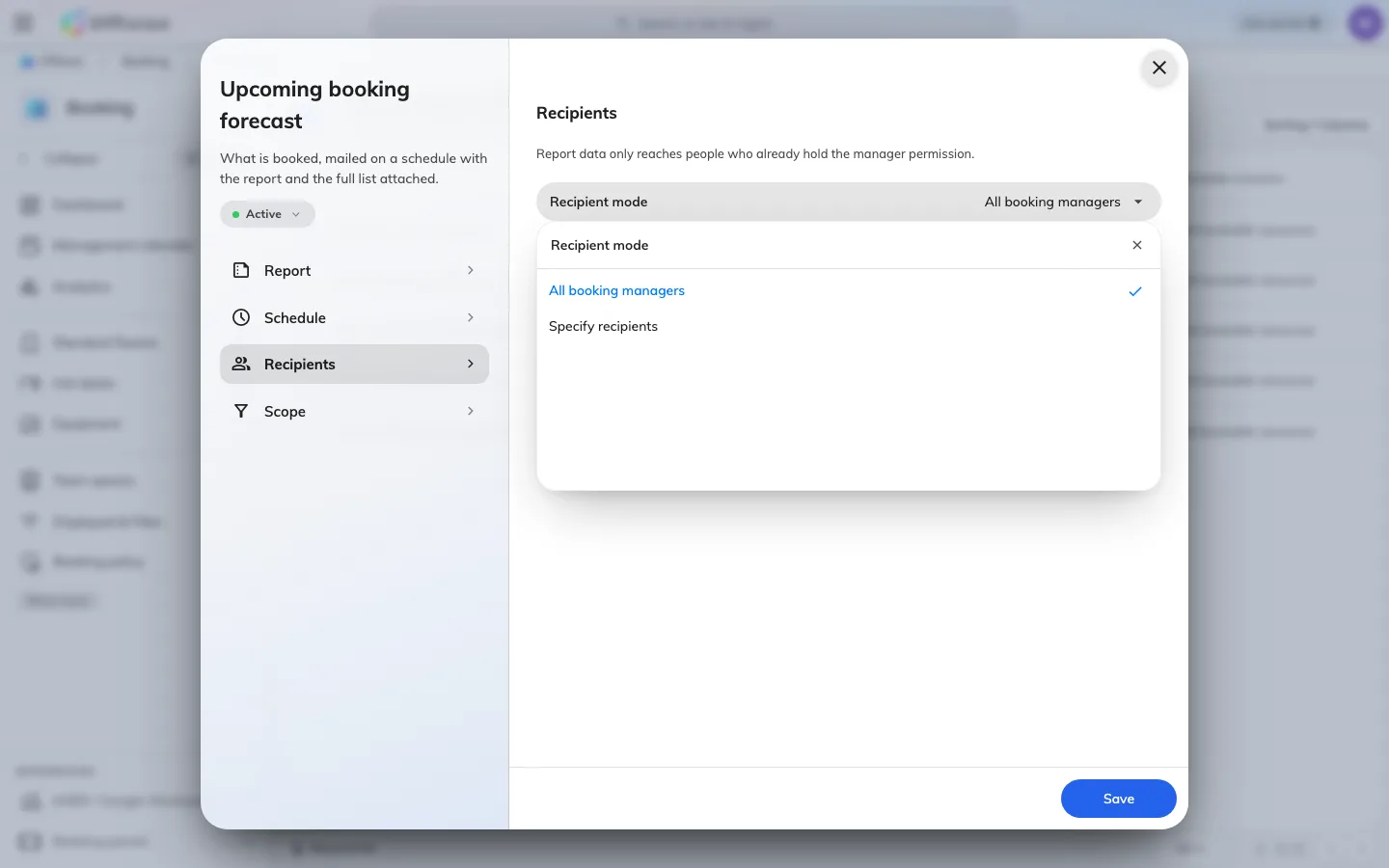
The two recipient modes.
5. Choose what it counts
On Scope, leave All bookable resources on and the report covers everything. Turn it off to pick specific rooms and desks — the way to give a department head a report about their own floor rather than the whole estate.
6. Read the mail before you save
Go back to Report. Under the two cards the dialog builds the email this subscription would actually send — who it resolves to after the manager filter, both attachments, and the report itself — and rebuilds it whenever you change a setting. No one would receive this report there means nobody you named holds Booking manager, which is the first cause in the list at the foot of this page, caught before the first send rather than after it.
Then choose Save.
7. Send one now to check
Select the subscription, and choose Send now in the panel on the right. The report goes out immediately, to its real recipients — this is a live send, not a preview, so expect the people you named to receive it.
What arrives
The email leads with the period it covers — tomorrow for a daily report, the next 7 or 14 days for a weekly or every-two-weeks one — then a headline count of expected bookings, with the change against the same number of days just gone. Then:
- Expected bookings per day, with the busiest day picked out
- Attendees, Organizers and Resources — how many in total, and how many distinct people and rooms
- A status bar — Approved against Awaiting approval
- Organizers booking the most — the people with the most bookings in the window
- Attached — the two files that ride along
View bookings opens the admin booking calendar already on the same window.
Two files ride along: a one-page PDF of the summary above, named
booking-forecast-<start>_<end>.pdf, and the full list as a spreadsheet named
bookings-<start>.xlsx.
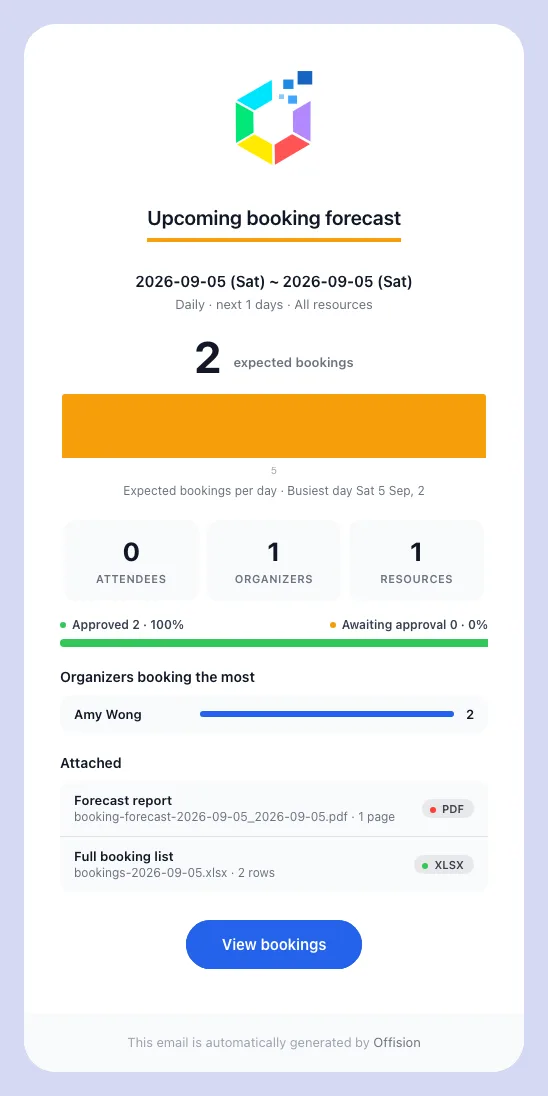
A daily forecast: the day covered, the headline count, and the files attached.
Two things about those files surprise people. They are named after the days
the report covers, not the day it was sent — a daily report sent on the 4th is
called bookings-2026-08-05.xlsx and booking-forecast-2026-08-05_2026-08-05.pdf.
And the counts deliberately leave out cancelled bookings, preparation time and
sub-resources, so they are usually lower than a raw count of rows in the
calendar.
The report also inherits your email branding — logo, colours and footer — from the same settings every other Offision email uses. To change the wording, pick the template type Upcoming booking forecast in the email template editor.
If the report does not arrive
Work through these in order:
- The recipients are not booking managers. The commonest cause by far. Everyone named, directly or through a group, must hold Booking manager or Global administrator; anyone else is dropped silently. If nobody on the subscription qualifies, nothing is sent at all.
- The subscription is paused. The list shows its status as Disabled. Open it and choose the Paused pill on the rail to start it again.
- The schedule can never come round. A weekly subscription with no day of week, or one whose hour has not occurred since you saved it, has simply not fired yet. Send now distinguishes the two: if that arrives and the scheduled send never does, the schedule is the problem, not the recipients.
- Email sending is not set up. If no Offision email reaches anyone, the problem is the sender rather than this report.
An empty report is not a failure. When nothing is booked in the window the report still arrives, showing zeroes and carrying an empty spreadsheet — that is the schedule working, and it is how you tell “nothing booked tomorrow” apart from “the report stopped coming”.