

Which booking panel hardware Offision supports
Every certified room and desk panel, model by model — screen size, PoE, Wi-Fi and card reader as the vendor states them, what an end-of-life marker means, and which cards each reader actually reads.
Offision does not make hardware. It certifies it: the panels below are the ones tested against every release, each with its own installation guideline in the connect wizard, and each buyable from the partner rather than from Offision. A panel that is not on this list is not blocked — it runs the browser player like any other screen — it is simply not one Offision tests.
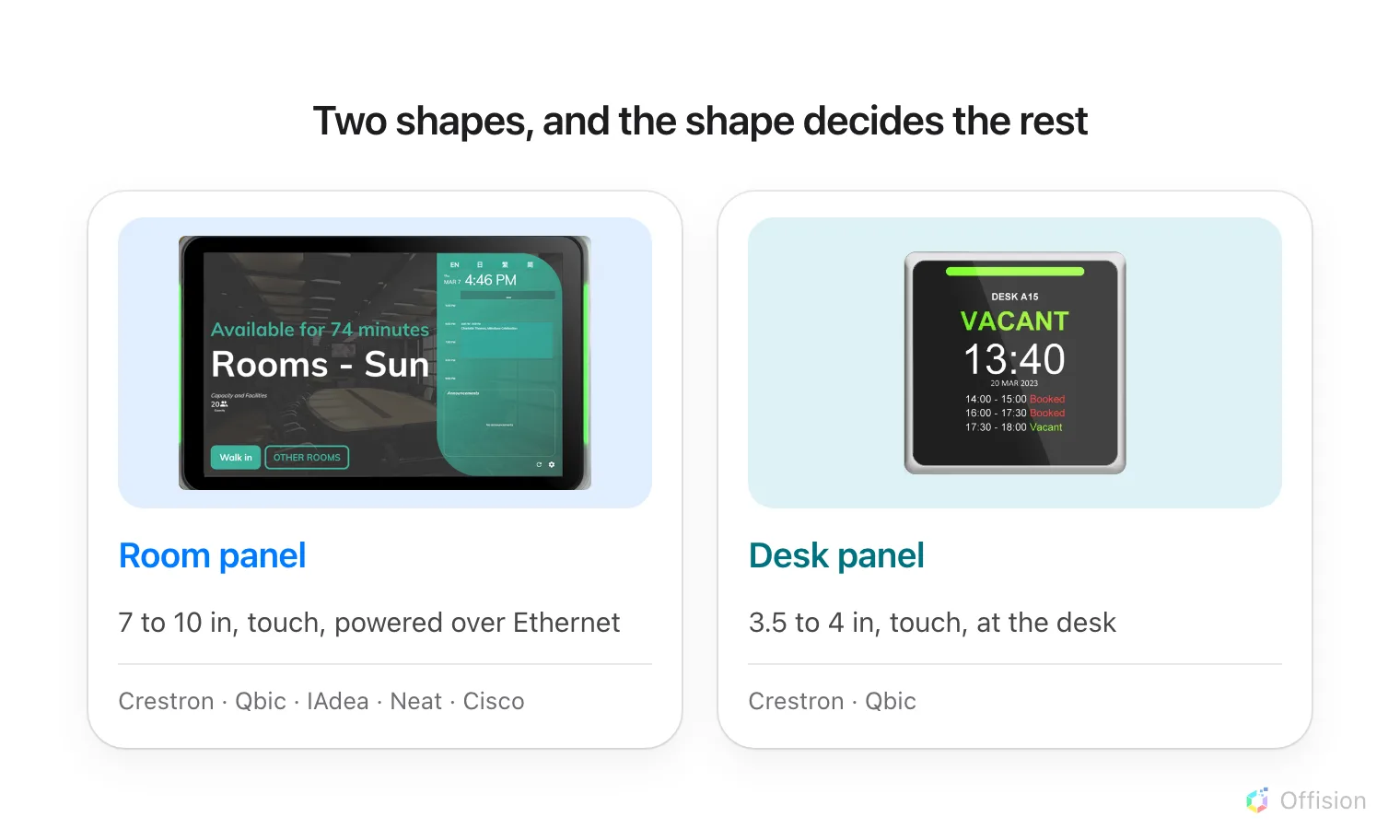
A panel is one of two shapes, and the shape decides the size, the power and where it hangs.
Room panels
The panel by the door. Every one of these is powered over its network cable, so the practical question at install time is whether the switch port can supply PoE+ rather than whether there is a socket in the wall.
| Model | Grade | Screen | PoE | Wi-Fi | Card reader |
|---|---|---|---|---|---|
| Crestron TSS-1080 | Commercial | 10.1 in, 1920 × 1200 | 802.3at PoE+, 30 W | Wi-Fi 6E, 802.11 a/b/g/n/ac/ax | USB reader |
| Crestron TSS-1070 / TSW-1070 | Commercial | 10.1 in, 1920 × 1200 | 802.3at PoE+, 15 W | 802.11 a/b/g/n/ac | USB reader |
| Crestron TSS-770 / TSW-770 | Commercial | 7 in, 1280 × 800 | 802.3at PoE+, 15 W | 802.11 a/b/g/n/ac | USB reader |
| Qbic TD-1050 Pro (end of life) | Commercial | 10.1 in | PoE | 802.11 b/g/n | Built-in NFC, 13.56 MHz. HID only on the H model |
| Qbic TD-1060 Slim | Commercial | 10.1 in, 1280 × 800 | PoE+ | 802.11 b/g/n/ac, optional | USB reader |
| Qbic TD-1070 | Commercial | 10.1 in, 1920 × 1200 | PoE+, 25 W | 802.11 b/g/n/ac, optional | Built-in NFC, 13.56 MHz. HID only on the H model |
| Qbic TD-1070 Lite | Commercial | 10.1 in, 1920 × 1200 | PoE+, 25 W | Wi-Fi 5, optional | Built-in NFC, 13.56 MHz. HID only on the H model |
| IAdea WRP-1000 | Commercial | 10.1 in, 1280 × 800 | 802.3at PoE+ | 802.11 a/b/g/n/ac | Built-in NFC, 13.56 MHz. HID only on the H model |
| IAdea XDS-1078-A9 | Commercial | 10.1 in, 1280 × 800 | 802.3at PoE+, 802.3af in eco mode | 802.11 b/g/n | USB reader |
| Neat Pad | Commercial | 8 in, 1280 × 800 | 802.3af, class 0 | Yes | USB reader |
| Cisco Room Navigator | Commercial | 10.1 in, 1920 × 1200 | Yes | — | USB reader |
Crestron’s TSS-880 is announced but not yet shipping, and is not in the connect wizard.
Desk panels
The small panel at the desk itself. Power is where these differ from each other: the Crestron takes PoE like a room panel, while the Qbic models run off USB from the desk — usually from the dock or the socket the desk already has, which is what makes them cheap to add to a desk that is already wired.
| Model | Grade | Screen | Power | Wi-Fi | Card reader |
|---|---|---|---|---|---|
| Crestron TSS-470E | Commercial | 3.5 in, 480 × 320 | 802.3af PoE, 6.5 W | 802.11 a/b/g/n/ac | USB reader |
| Qbic TD-0350 (end of life) | Commercial | 3.5 in, 480 × 320 | USB | 802.11 b/g/n, optional | Built-in NFC, 13.56 MHz. HID only on the H model |
| Qbic TD-0360 | Commercial | 3.6 in, 480 × 480 | USB | Wi-Fi 5 | Built-in NFC, 13.56 MHz. HID only on the H model |
| Qbic TDD-1000 | Commercial | 3.9 in, 480 × 480 | USB-C, also charges a laptop | Wi-Fi 5 | Built-in NFC, 13.56 MHz. HID only on the H model |
The Qbic TDD-1000 is a dock as well as a panel: the same USB-C cable that powers it charges the laptop plugged into it, which is why it appears at hot desks where the point is that people bring their own machine.
Tablets and other devices
Under Certified devices in the connect wizard sits Other devices: an iPad, an Android or Windows tablet, or a third-party screen with a web view. Each runs the same panel and books the same rooms, and each gives up PoE, the light bar, and — on everything but an Android tablet — the built-in card reader. They are also a grade down: a tablet is consumer hardware, built for intermittent personal use rather than for being left on a wall all day. What each one needs, and what it costs you, is in Use a tablet as a booking panel.
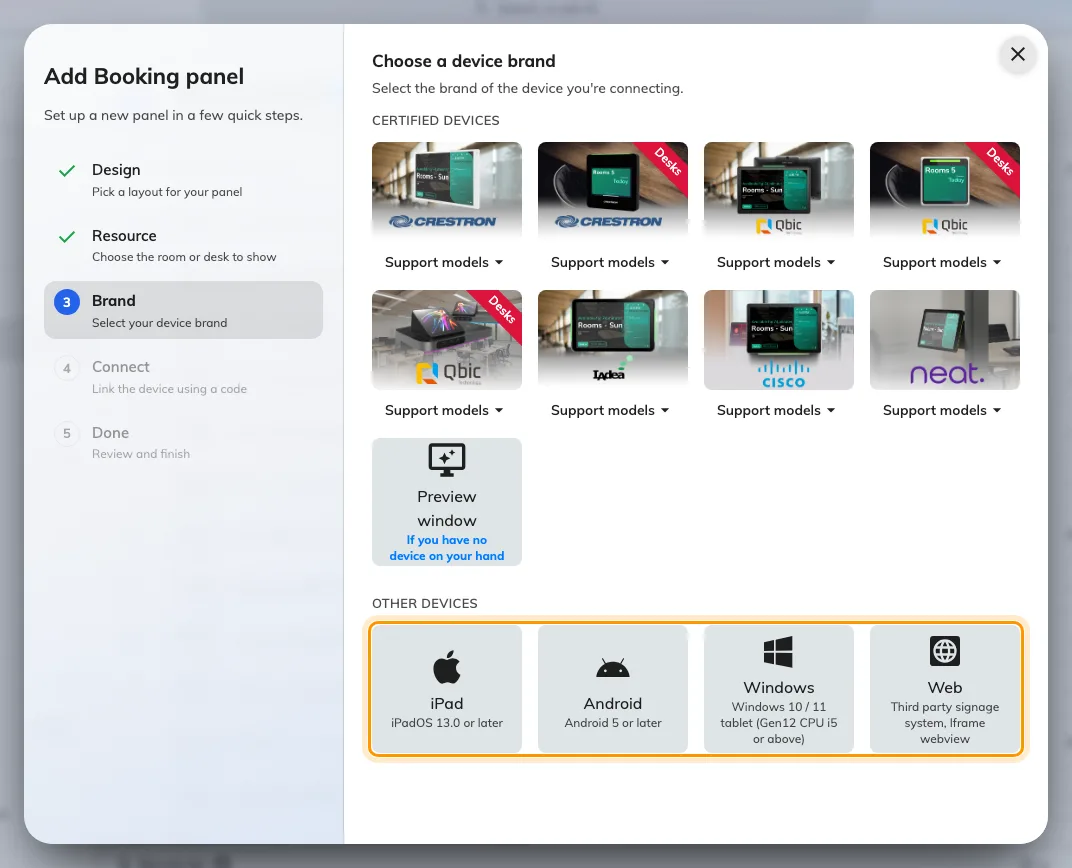
Other devices, under the certified tiles in the connect wizard.
What Offision drives on each one
The tables above are the hardware. What Offision actually does with it — the light bar it can colour, how a card is read, and which panels it can reboot — is a different question, and it is answered panel by panel in What Offision drives on each panel.
What the columns mean
Grade is the environment a panel is built for. Every model here is commercial grade: made by an AV or signage manufacturer for continuous, unattended use in an office, a lobby or a corridor. None of them is industrial grade. No panel on this page carries an IP rating, a dust or vibration figure or an extended temperature range, and none is certified for a plant floor, a warehouse aisle or an outdoor wall. Where the environment is the question, the figures are the manufacturer’s — ask your supplier for the model’s datasheet.
PoE is how nearly every room panel is powered, and PoE+ is not PoE: a switch port that only meets 802.3af will bring up a Neat Pad and a Crestron TSS-470E but not a Qbic TD-1070, which asks for 25 W. Check the port budget on the switch, not just the standard printed on it.
Card reader splits two ways. Built-in NFC means the panel has its own 13.56 MHz radio behind its face and a card is tapped on the panel itself — bottom centre on a TD-1050, bottom right on a TD-1070, bottom centre on a WRP-1000. USB reader means a separate reader is plugged in, behaves as a keyboard, and is where people tap instead. Both end up in the same place; see Check in by tapping a staff card.
End of life means Qbic no longer sells that model. A panel already on the wall keeps working and is still tested against every release — the marker is there so nobody orders one for a new install, or budgets for fifty and finds they cannot be bought. Ask your supplier what replaces it, and put the new one on the record the old one was on — Replace a panel that has failed.
What this does not control
- Certification is not a licence. Connecting any panel needs Hardware, whatever the brand.
- The brand you pick in the wizard does not change what the panel can do. It decides which installation guideline you are shown; the capabilities are the hardware’s, and they are the tables above and in What Offision drives on each panel.
- A panel not on this list still works. It runs the browser player, with no light bar and no built-in card reader — the same profile as a tablet in a browser.
- E-paper room and desk displays are not booking panels and are not covered here. They run no player, take no touch and are driven as their own system — see Connect Qbic e-paper tags.