

Visiting data set reference
Create a data set, the reusable list of options a visiting form's Autocomplete fields read from — a key, a display text, and an import. Every setting on the screen, and when to use one instead of a Select field.
A data set is a reusable list of options that Autocomplete fields on a visiting form read from. Define it once and every visiting form can use it — which is what separates it from Select, whose options live on the one field that declares them.
Reach for a data set when the list is long enough that scrolling a Select is a chore, when more than one field asks the same question, or when the answers have to reconcile with a code another system already uses.
Open Visiting data setEvery setting
| Setting | What it does | When to change it |
|---|---|---|
| Name | Names the data set in the picker on a field | Name it after the list, not after the field that first needed it |
| Entries | The rows themselves | |
| Key | The code stored alongside the answer | Set it to whatever your other system reconciles on. Renaming the display text later then leaves past visits intact |
| Display text | What the person filling the form reads | Fill it in for every language your site uses — text given only in English renders in English on a Japanese screen |
| Import from Excel | Loads the rows from a spreadsheet | For any real list — a tenancy register is not worth typing |
| Export | Writes the rows back out | Take one before a bulk change, so a bad import can be undone |
| Select, Delete, Delete all | A tick on each row, with Shift-click for a range and a box to tick them all; Delete removes the ticked rows and Delete all empties the list. Nothing is removed until the data set is saved | For clearing out stale entries, or emptying the list before a fresh import |
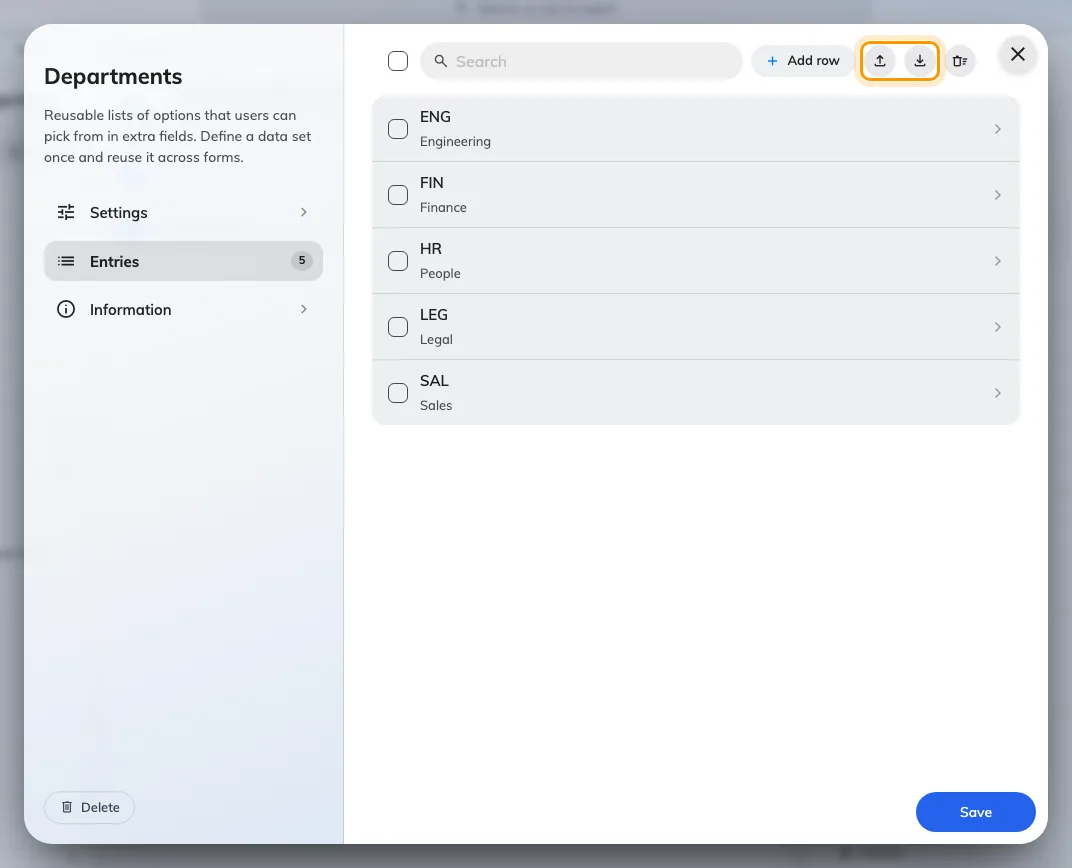
A visiting data set and its entries. Import and Export are the two icon buttons above the list.
What this does not control
- Which fields use it. A data set is offered to a field only once that field’s type is Autocomplete — see Visiting form reference.
- Booking’s data sets. Visiting keeps its own catalogue. A set built for booking does not appear in the picker here, and the two never share entries.
- Visitor attributes. Those are a separate set of fields kept against a person, on their own screen.