

Directory
Everyone with an Offision account — how they get one, what they are allowed to do, and the devices they are signed in on.
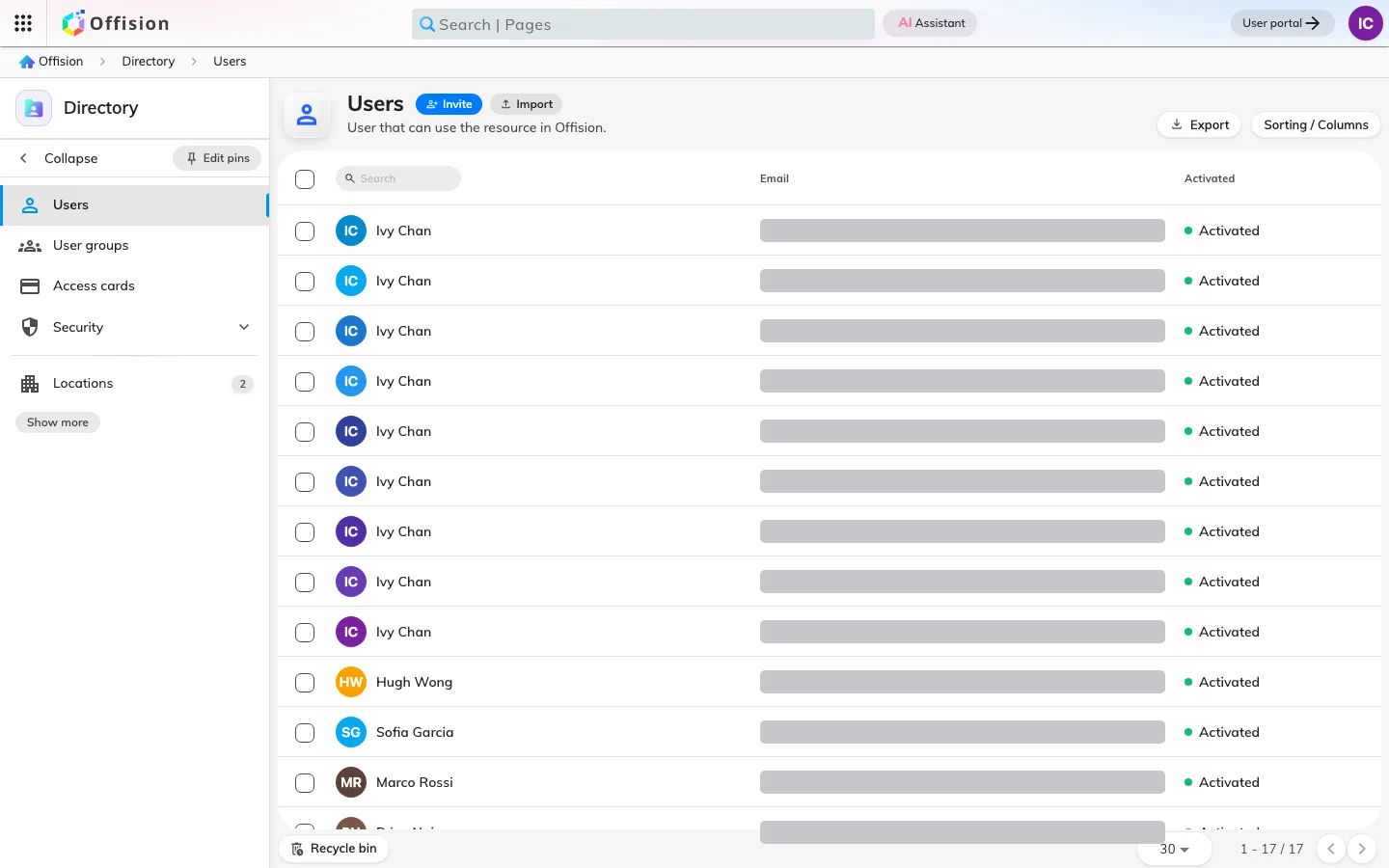
Directory is the answer to two questions the rest of Offision keeps asking: who is this person, and where are they. People, the groups that describe them, and the buildings and floors everything else is filed under all live here.
People, and the groups that stand in for them
An account arrives one of three ways — invited one at a time, imported from a spreadsheet, or synced from Microsoft 365 or Google Workspace. What it can do afterwards is a permission, and the sane place to put a permission is a user group rather than a person.
That is the habit worth forming early. A group is how one decision reaches many people: permissions, which rooms a team can see, and how much quota they share are all set on a group and inherited. Set them per person and you will be setting them again every time somebody joins.
The card in somebody’s pocket
A person’s access card lives here for the same reason: the number on it belongs to them, not to a room. Store it once and every panel in the estate knows them by it — to check into a meeting, claim a desk, clock in, or open a door alongside the booking. It is not a permission, and it is not a way to sign in; it is only a second name Offision knows them by.
Getting in, and staying in
Two separate mechanisms decide sign-in, and they cover different populations. The password policy binds passwords Offision itself issues. Security profiles bind everybody, including people who arrive through Microsoft 365 or Google — so a company that has moved sign-in to a provider is still governed here.
Login devices are the third piece and the one that surprises people. Every sign-in leaves a device behind, and it stays valid for thirty days. Deactivating the account does not end it and neither does a new password: signing the device out is the only thing that does. That is the step when a phone is lost.
Buildings and floors
Every room, desk, panel and screen sits on a floor, and every floor sits in a building — which is why buildings are here rather than in Booking. A building also carries its time zone, and it takes it from the pin on the map rather than from a field, so a site placed wrongly reports the wrong local time everywhere it appears.
One account, several sites
An organisation with more than one campus, office or region can divide the account into branches, and file every building — and every administrator — under one of them. An administrator then manages their own branch and everything under it, sees what the branches above them set, and never meets the branch beside them. It is the answer to “our site managers keep editing each other’s rooms”, and it is set on the person rather than on their permissions.
What Directory does not cover
What a person may book is not a permission — it comes from team spaces, booking rules and quota in Booking. Someone from outside the company who is expected at reception has no account at all; they are a visitor, in Visiting.