

Remind participants before the day
Your event reminds nobody unless you add a reminder to it — and four things will quietly stop one that is already scheduled.
Reminders belongs to your event, and there is no company-wide default. An event with an empty list reminds nobody.
That absence is silent, which is the trap: a carefully built event with a hundred registrations will say nothing to anybody unless you add a reminder yourself.
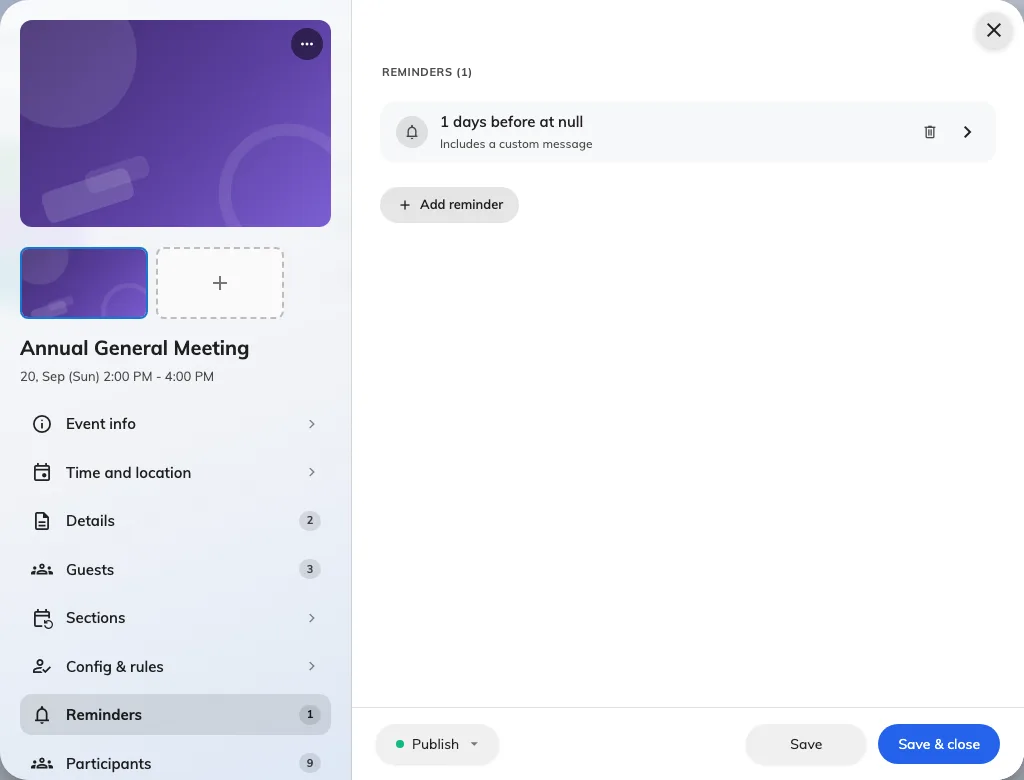
Reminders are set per event, on their own page of the editor.
The two ways to time one
Before start counts backwards from the event — 30 minutes, 2 hours, 3 days. Use this for almost everything, because it follows the event if the date moves.
Exact time fires at a moment you name. Use it when the reminder is tied to something else, like a catering deadline.
A Before start reminder measured in Days also asks for a Send at time, since “three days before” without an hour would fire in the middle of the night. Left blank it sends at 09:00, in the event’s own time zone.
Each reminder can carry an Extra message — a line added to the standard mail, for parking, dress code, or what to bring.
Who gets one
Everybody still expected: invited, invitation sent, and already checked in. Anybody cancelled or marked no show is left out, so a reminder never chases somebody who told you they were not coming.
Both audiences are treated alike. A colleague who signed themselves up and got no confirmation will still receive reminders.
How many
Two is usually right: one a few days out, so people can rearrange, and one on the morning. A reminder an hour before is only useful for something people walk to.
On a series event, Before start reminders follow each section — so two reminders on a four-section course is eight emails per person. Count before you set them.
What language they go out in
Reminders are written in one language for everybody — never in each person’s own. By default that is the company’s email language, and for most events you should leave it there.
An event running in another language can say so. The Email language card on the event’s Public design page takes a Primary language, and a Secondary one if you want both in the same message. Leave Primary on Same as system to follow the company setting.
Set it before you invite anybody: the same choice governs the confirmation email and the wallet pass, so changing it later leaves already-sent mail in the old language while new mail arrives in the new one.