
 Neat
Neat
 Crestron

Project Details
Client Overview
A premier global real estate investment, development, and management group headquartered in Singapore. Operating across two major commercial towers, the organization sought to modernize its workplace experience for a massive workforce of over 1,400 active users.
The Challenge
Managing a large-scale transition to hybrid work presented significant logistical hurdles:
High-Volume Desk Management: Over 1,000 desks required a system that could handle high daily turnover without user frustration.
Specific Hardware Needs: Employees had varying technical requirements (e.g., single vs. dual monitors) that weren't visible in their legacy system.
Complex Room Scheduling: Coordinating over 120 meeting rooms across multiple floors and wings was prone to inefficiency.
Geographic & Team Silos: The organization needed a way to partition resources so that specific teams could only access their designated zones across two different office towers.
The Offision Solution
1. High-Density Hot Desking with Smart Filtering
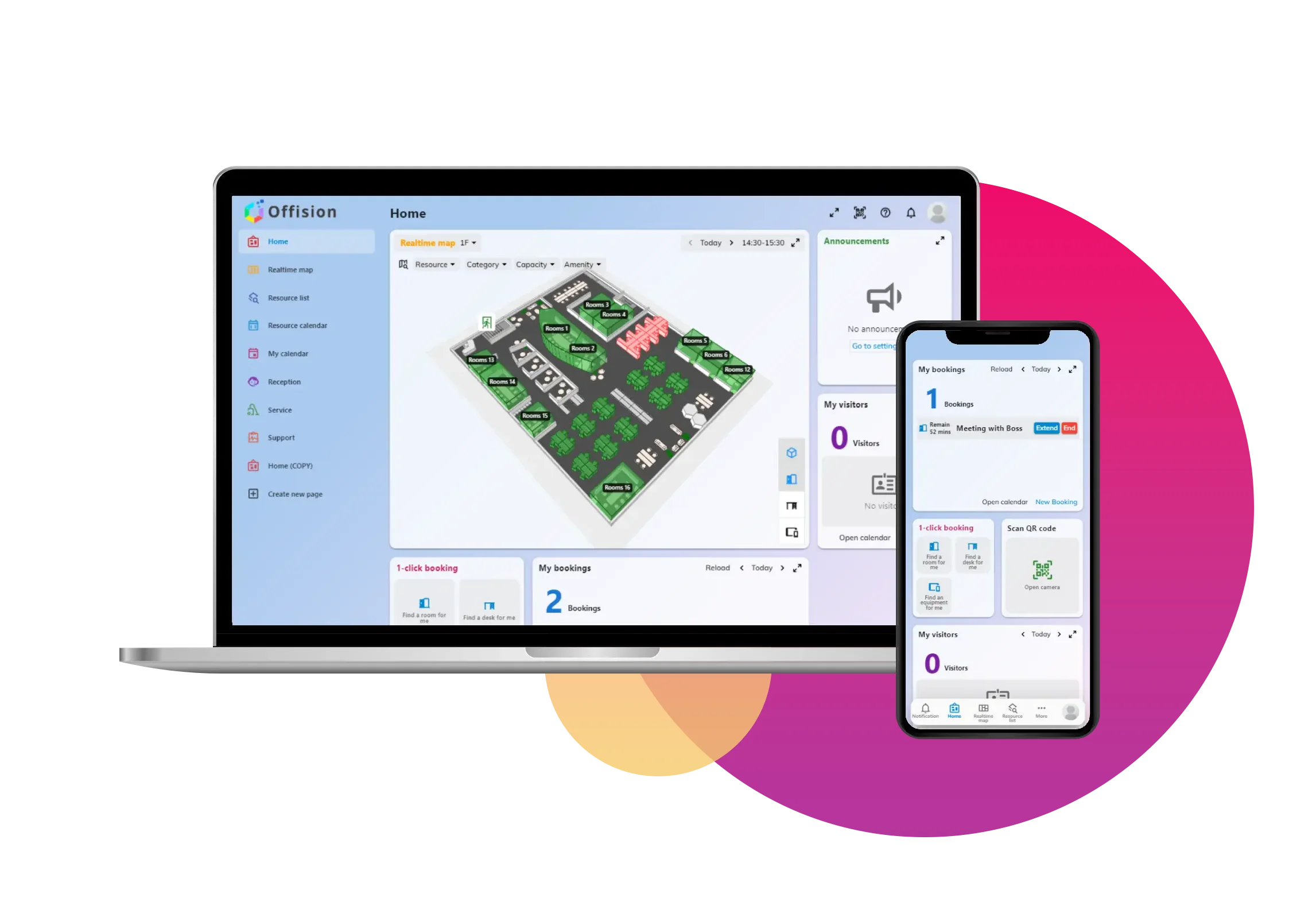
To manage the 1,000+ desk inventory, Offision implemented a high-performance hot desking module.
Hardware-Specific Filters: Users can instantly filter the floor plan to find desks equipped with one, two, or no monitors. This ensures that data analysts or designers get the screen real estate they need without wandering the office.
Live Occupancy Maps: With 1,400 users, visibility is key. Real-time heatmaps show which zones are nearing capacity, allowing staff to book seats near their immediate collaborators.
2. Scalable Meeting Room Management
With over 120 meeting rooms in the system, Offision streamlined the reservation workflow.
Centralized Control: Admins can manage 120+ rooms from a single dashboard, while users can filter rooms by capacity, AV equipment, or specific tower location.
Integration: The system syncs seamlessly with their corporate calendars, eliminating ghost bookings and ensuring high utilization of premium real estate.
3. Multi-Tower "Team Space" Architecture
To manage the complexity of two distinct office towers, Offision utilized the Team Space feature to create a hierarchical permissions model.
Location-Based Partitioning: Resources are categorized by Tower A and Tower B, ensuring users see the most relevant spaces first.
Departmental Allocation: Specific desk clusters and meeting rooms are "locked" to certain teams (e.g., Finance, HR, or Project Teams). This ensures that while the office is "hot," teams still have a "home base" within their assigned tower.
Cross-Tower Flexibility: While desks are prioritized for specific teams, admins can open up surplus capacity to the wider 1,400-user pool during peak periods.
4. Dynamic User Growth & Licensing
The system was designed to handle the scale of a Tier-1 enterprise.
1,400+ User Support: The platform maintains high responsiveness despite the high volume of concurrent bookings and check-ins.
Automated Provisioning: Integration with the client's HRIS/Active Directory ensures that as the company grows, new employees are automatically assigned to their respective Team Spaces and Tower profiles.
The Result
The implementation successfully consolidated two major office towers into one cohesive digital ecosystem. By empowering 1,400 users to self-serve their workspace needs—whether it's a dual-monitor desk or a large boardroom—the organization has seen a significant reduction in administrative overhead and a marked increase in employee satisfaction regarding the hybrid work experience.