
Coming into the office only helps when the day itself works. Some work needs a quiet place to concentrate. Other work needs the right people close enough to talk. If every desk is asked to do both jobs at once, people who came in to focus get interrupted, and people who came in to collaborate cannot tell who is actually free.
Here is a practical way to make the days people already spend on site more useful — without adding attendance days, and without treating a software rollout as a guarantee.
Start with the purpose of the day
Before anyone books a seat, be clear about the next stretch of work. Is this a focus block, a collaboration day, or a mix? That choice should drive where people sit.
A quiet desk is a poor place for a workshop. A busy collaboration zone is a poor place for deep writing or analysis. You do not need a new attendance policy to fix this. You need a habit: choose the purpose, then choose a space that matches it.
A five-step workflow
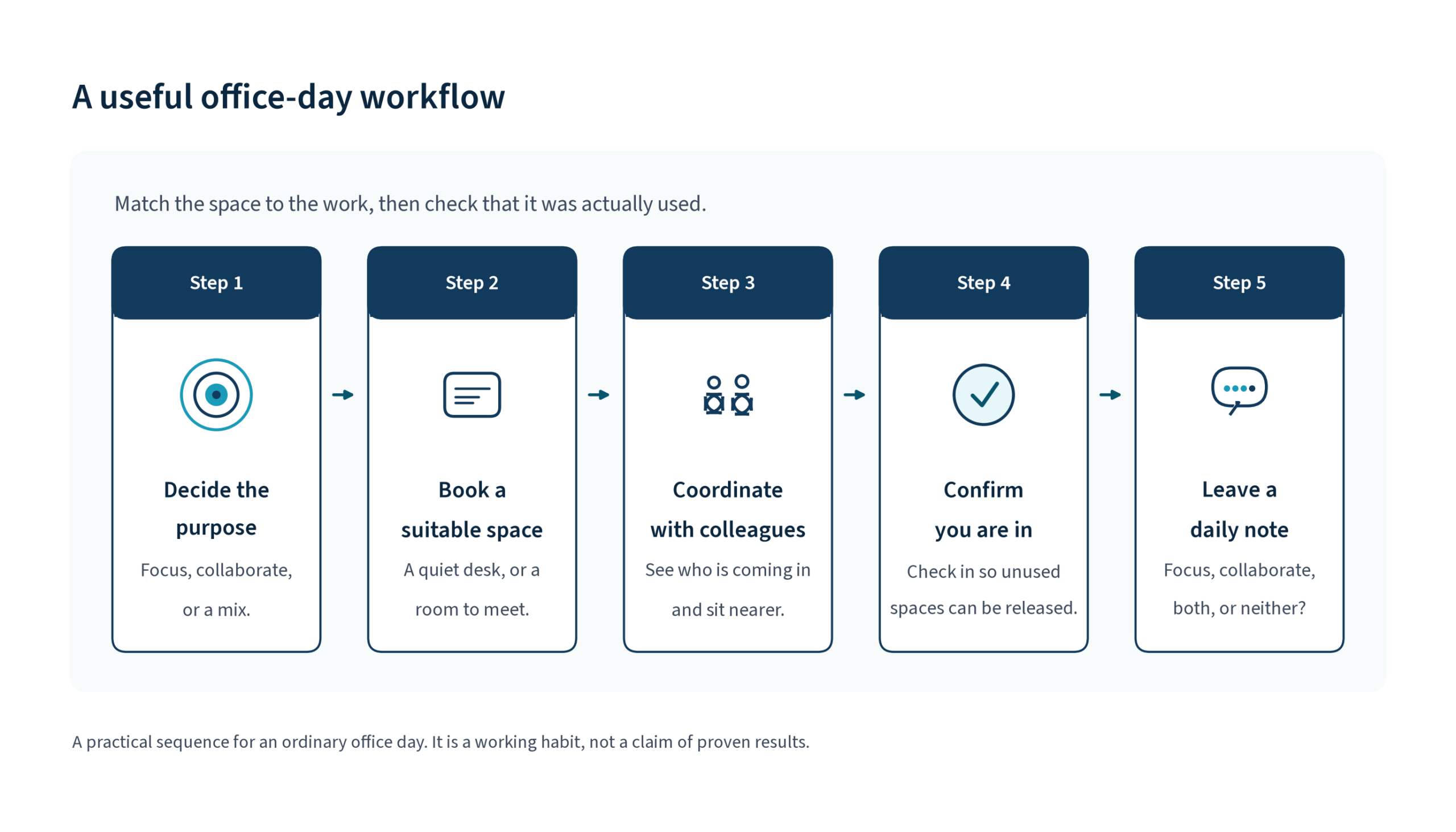
- Decide the purpose — focus, collaboration, or a mix.
- Book a suitable space — a quiet desk for concentration, or a room when you need to meet.
- Coordinate with colleagues — on days the team has already agreed to come in, sit nearer one another so a conversation does not have to be hunted down.
- Confirm you are in — check in on arrival so a reserved desk or room is known to be in use, and can be released if it is not.
- Leave a daily note — one question is enough: did today help you focus, collaborate, both, or neither?
Offision is built for this loop. You can book desks and rooms that fit the work, see who has reserved a desk or room so teams can sit together on agreed days, and check in on arrival — including mobile and QR check-in, with auto-release and no-show rules. On assigned desks, colleagues can see whether someone is at their seat or away, based on check-in.
Treat that as planned and confirmed presence, not a complete picture of the building. People who were only invited to a meeting, or who sit down without booking, will not appear on the map. If someone skips check-in, a booking may be marked unused even though they were there. Read the figures with those limits in mind.
Try it for three weeks, with a baseline week
This is a practical suggestion, not a proven programme. Keep attendance days the same throughout. The aim is to improve the days you already have, not to test a stricter office rule.
Spend one baseline week working as you do now, and record two measures. Then run the workflow for three weeks and record the same measures again.
Unused-booking rate. Count in-scope desk and room reservations with no qualifying check-in (or other agreed confirmation of use), and divide by all in-scope reservations in that week:
Unused-booking rate = unused bookings ÷ all in-scope bookings
Set the check-in rule in advance — for example, no check-in within a set time, after which the reservation is treated as unused. The denominator is bookings, not people: one person can hold more than one reservation. If check-in is patchy, the rate will look worse than reality, so keep a note of how complete check-in was.
Useful-day feedback. Ask everyone who came in a single daily question: did today help you focus, collaborate, both, or neither? Report all four shares, not only a combined total. A “useful-day” figure can add together focus, collaborate and both, but the split tells you more. Count only in-office responses, not the whole workforce. Record missing answers as missing — do not fold them into “neither”.
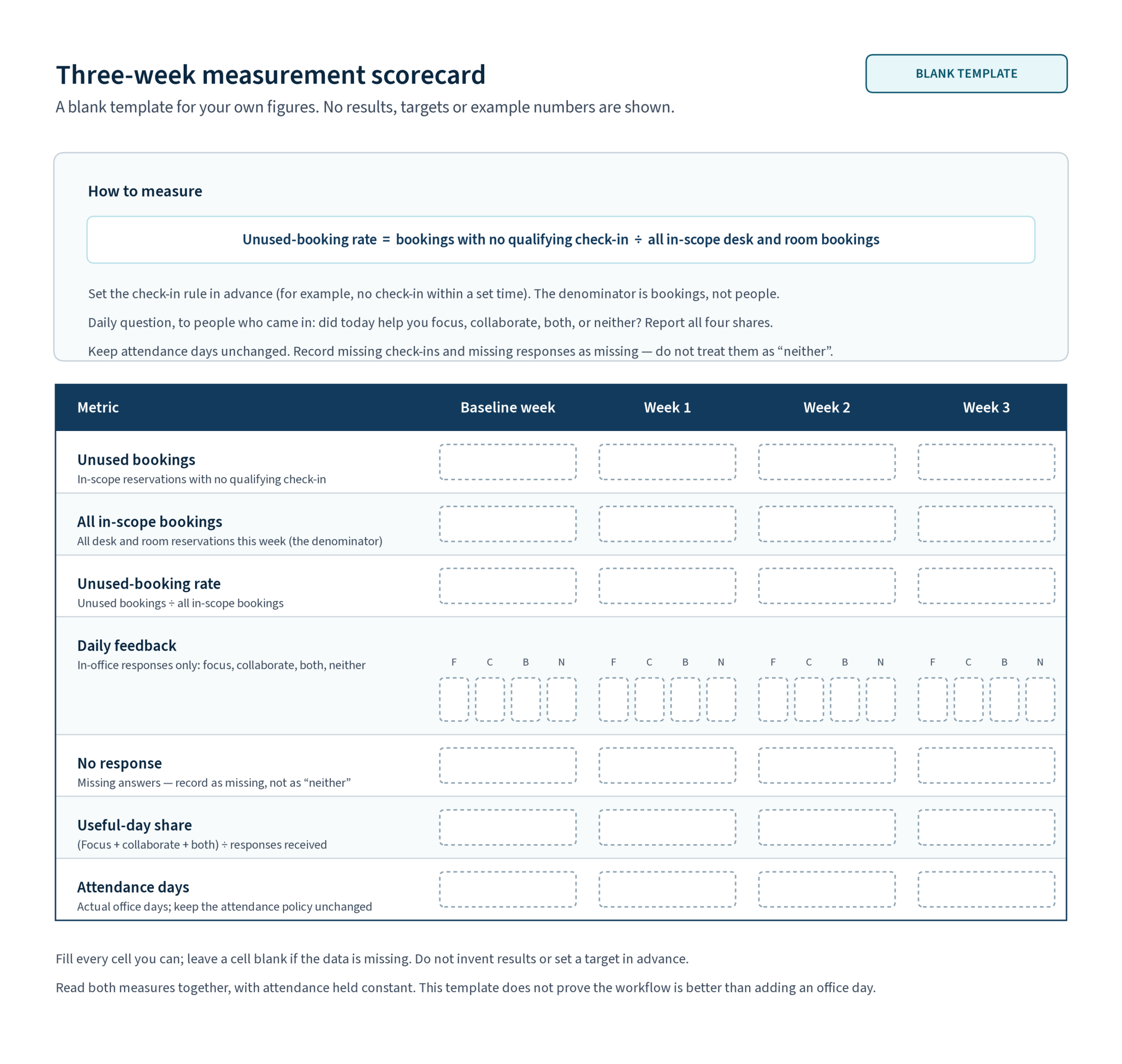
Use the scorecard as an empty template. Fill it with your own figures as the weeks run, and leave a cell blank if the data is missing.
Look at both measures together, and keep an eye on attendance days so you can confirm the policy did not creep up. A useful pattern to look for is fewer unused bookings and a higher share of useful office days, with attendance unchanged. A quiet week, a holiday, or a change in who came in can move the figures too, so treat the comparison as a signal rather than a verdict. This design also cannot show that the workflow is better than adding an extra office day: it does not test that question.
What it can do is give you a clearer view of whether office days are doing the two jobs people actually come in for: concentrating, and finding the people they need.
If you want to coordinate desks, rooms and who is due in, start at offision.com.
Leave a Reply