
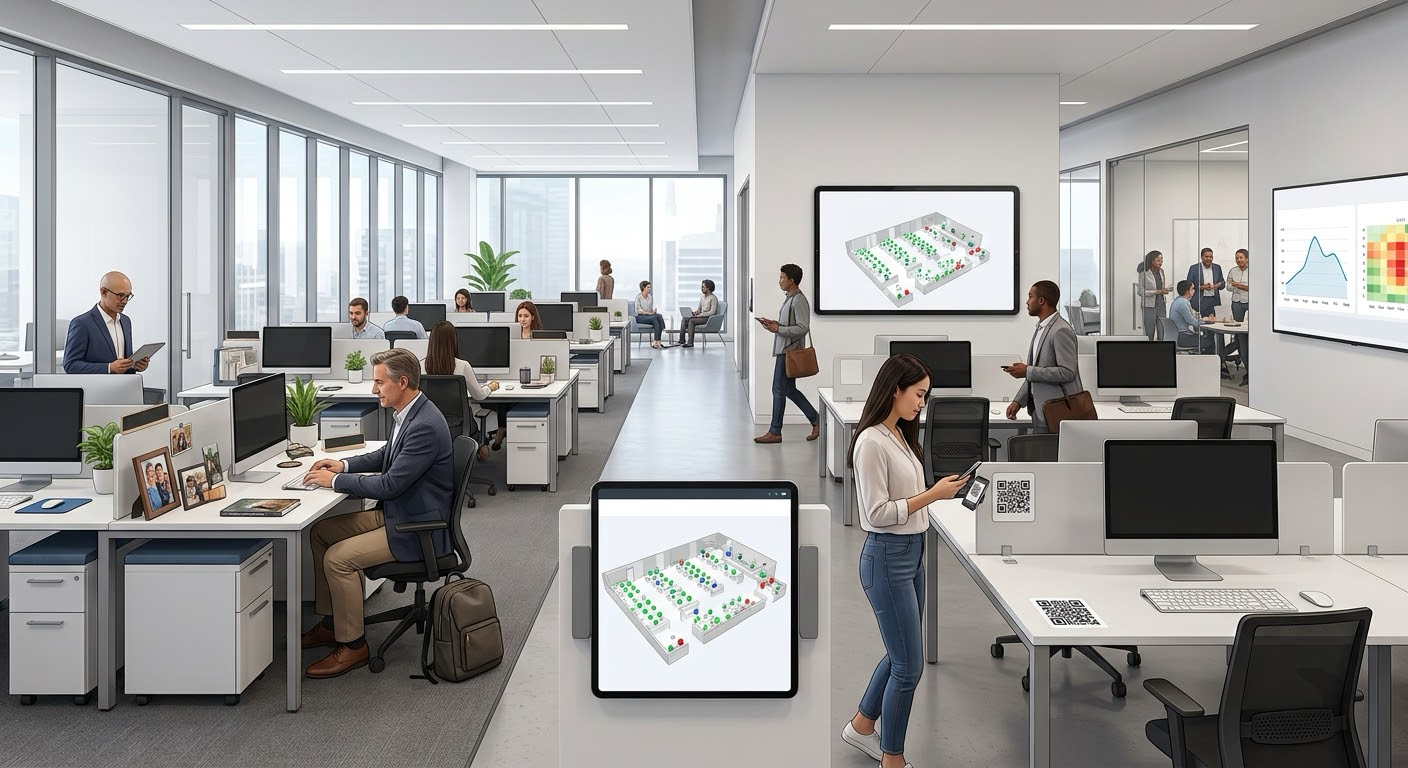
Hybrid offices still ask the same question: fixed desk for everyone, or book a seat when you come in?
For the broader operating context, see workplace management software for hybrid offices.
Direct answer: Desk booking reserves a shared workstation for a day or half-day, while assigned seating gives each person a permanent desk. Assigned seating fits stable attendance and teams that need adjacency; desk booking fits variable attendance and shared capacity.
In 2026 this is not a trend debate. It is a capacity decision. Some teams need a predictable home base. Others share fewer desks than people. Most end up with a mix.
At a glance
| Assigned seating | Desk booking | |
|---|---|---|
| Who owns the desk | One person, full time | Shared; reserved by day or half-day |
| Wins on | Certainty and adjacency | Utilization and flexibility |
| Best when | Stable, high on-site days | Variable hybrid attendance; desk ratio under 1:1 |
| Main risk | Empty seats on remote days | Ghost bookings and weak maps |
Rule of thumb: Assigned seating buys certainty. Desk booking buys flexibility. Hybrid offices often need both.
Assigned seating
Everyone gets a permanent desk. Teammates sit where you expect. Personal gear stays put.
Use it when people are in the office four or five days a week, the team must sit together, desks are specialized, or culture expects a home base.
Watch out: A desk reserved for someone remote three days a week is unused capacity. Across a floor, that cost adds up fast.
Even in an assigned-first office, keep a small flexible pool for visitors, contractors, and peak overflow.
Desk booking (not walk-up hot desking)
People reserve a desk before they commute—usually from a floor plan—then check in on arrival. Unclaimed seats auto-release back into the pool.
Standardize the shared-seat setup with the hot desking equipment checklist.
That is different from first-come hot desking, which fails on busy midweek days when people commute in and find nowhere to sit.
Use it when Mondays and Fridays are quiet and midweek is packed, desk count is below headcount, teams share floors, or leaders need utilization data before changing the lease.
A strong pattern for 2026: neighborhoods—teams keep a zone on the map, but desks inside it are bookable. Adjacency without locking every chair as private real estate.
Hoteling vs. hot desking vs. assigned desks
Hoteling means booking a specific desk for a set time, often in a team neighborhood. It differs from first-come hot desking, where people take any available seat, and from an assigned desk, which stays with one person.
Where both models fail
- Office-day mandates without enough seats Peak demand beats policy.
- Ghost bookings No check-in, no trust.
- All-or-nothing flips — Overnight hot desking (or zero flexibility) creates backlash. Pilot a mix.
- No find layer — If seats move daily without maps or neighborhoods, collaboration drops.
- Ignored exceptions — Labs and regulated roles often still need assigned desks. Name them.
How software helps
Map the desks. Set rules. Show what is free. Measure use.
You want: live floor plans, assigned and bookable desks on one map, neighborhoods, check-in and auto-release, occupancy analytics, calendar/SSO integrations, and wayfinding so people find their seat without asking reception.
Offision supports that dual setup—bookable desks and fixed seats on the same floor plan—alongside rooms, visitors, and analytics. See desk booking, floor plan & wayfinding, and interactive wayfinding for the workplace. For Microsoft 365 and Places fit, see the workplace ops layer guide.
Quick decision
- Stable attendance + must sit together → lean assigned (plus a small flexible buffer).
- Swingy hybrid days + scarce desks → lean desk booking with neighborhoods.
- Different answers by floor or team → mixed model on purpose.
Pilot tip: One floor. Mark true assigned exceptions. Make the rest bookable. Add neighborhoods and check-in. Review after two to four weeks. Then scale.
FAQ
What is the difference between desk booking and assigned seating?
Desk booking reserves a shared desk for a set day or half-day. Assigned seating gives one person a permanent desk.
When does assigned seating still win?
It fits stable attendance, specialized desks, and teams that need to sit together.
What is hoteling, and how is it different from hot desking and assigned desks?
Hoteling reserves a specific desk for a set time, often in a neighborhood. Hot desking is first-come, while an assigned desk stays with one person.
What does a workplace system add beyond Outlook?
It connects booking rules and check-in with floor plans, desk availability, wayfinding, and utilization visibility—not just calendar entries.
Key takeaways
- Assigned seating maximizes certainty; desk booking maximizes utilization.
- Most hybrid offices need a mixed model.
- Flexible seating fails without check-in, neighborhoods, and an honest floor plan.
- Decide on peak demand and desk-to-headcount—not on trend labels.
- Software should run assigned and bookable desks on one map.
Direct answer
Desk booking lets people reserve a shared workstation for a day or half-day from a live floor plan. Assigned seating gives each person a permanent desk. Assigned fits stable, high on-site attendance and teams that must sit together. Desk booking fits variable hybrid schedules and offices where desks are fewer than people.
In 2026, many workplaces combine both: fixed desks where work demands them, bookable seats (often in team neighborhoods) everywhere else. It works when policy matches peak demand, check-in kills ghost bookings, and one workplace platform shows availability, maps, and utilization together.
Leave a Reply