

In the post-pandemic era, the debate over remote, hybrid, and in-office work continues to evolve. While many companies embraced flexibility during the height of COVID-19, recent trends show a shift toward more structured policies.
According to data from Flex Index, 71% of Fortune 100 companies still offer some form of flexible work arrangements, but there’s a clear tightening of requirements, with nearly half mandating four or five days in the office. This reflects a broader push among large corporations to bring employees back to physical workspaces, balancing productivity, collaboration, and employee satisfaction.
Key Statistics on Fortune 100 Work Policies
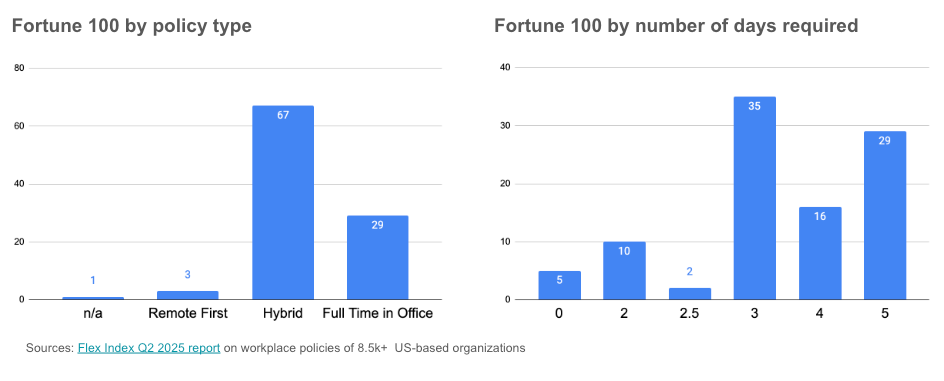
Breakdown of Fortune 100 policies by type and required office days (Flex Index Q2 2025).
The latest insights reveal a nuanced picture:
- Flexible Policies Dominate, But With Strings Attached: 71% of Fortune 100 firms maintain flexible options, down slightly from previous years but still the majority. The most common setup is a 3-day hybrid model, adopted by 35% of these companies. This allows employees to split their week between home and office, often with designated “anchor days” for team meetings.
- Full-Time Office Requirements: 29% of Fortune 100 companies now require full-time in-office presence (5 days a week), a notable increase from earlier figures like 5% in Q2 2023.
- Tightening the Reins: Perhaps the most telling trend is that 45% of these top firms demand either 4 or 5 days in the office. This means nearly half of Fortune 100 workers are expected to be on-site almost daily, signaling a move away from looser hybrid arrangements. For context, the average weekly office requirement has risen to 3.8 days in 2025, up from 2.6 days in 2023.
Here’s a quick breakdown in table form for clarity:
| Policy Type | Percentage of Fortune 100 Companies |
|---|---|
| Hybrid (Various Days) | 67% (including 35% at 3 days) |
| Full-Time In-Office | 29% |
| Remote-First or Other Flexible | 4% (including 3% remote-first) |
| Required Office Days | Percentage |
|---|---|
| 0-2.5 Days | 17% |
| 3 Days | 35% |
| 4 Days | 16% |
| 5 Days | 29% |
These numbers come from Flex Index’s ongoing tracking of over 10,000 companies, highlighting how larger firms like those in the Fortune 100 are more likely to enforce stricter policies compared to smaller or newer startups, where flexibility remains over 90% in many cases.
Why the Shift Toward Stricter Policies?
Several factors are driving this trend. Executives at major corporations often cite the need for better collaboration, mentorship opportunities, and company culture as reasons for requiring more office time. However, the data also shows a disconnect: while policies have tightened (with required days up 10% in the last year), actual office usage has only increased by 2-3%. This suggests employees are pushing back or finding ways to maintain flexibility in practice.
Additionally, broader market data indicates that office vacancies in the US hit a record 22.5% in Q2 2025, implying that full returns to office aren’t happening en masse despite mandates. Smaller companies and tech startups, in contrast, continue to prioritize remote-first models to attract talent.
Implications for Workers and Businesses
For employees, this tightening could mean reassessing job satisfaction and work-life balance. Surveys show that 6 in 10 remote-capable workers prefer hybrid setups, and 92% of top-rated companies offer them. Businesses, meanwhile, must navigate retention risks—strict policies might drive talent to more flexible competitors.
Looking ahead, the Fortune 100’s approach may set the tone for other sectors, but with ongoing debates and economic uncertainties, hybrid work isn’t going away entirely. It’s evolving into a more disciplined version that aims to blend the best of both worlds.
Leave a Reply